

This last week has been a challenge. As I move forward with exploring my call to ministry in the UMC, conversations with leaders in my conference and district are challenging levels of internalized theology that I didn’t even realize. I tweeted about this a while back, discussing the Imago Dei as genderless. I am still wrestling with the implications of that conversation and trying to moderate my language to reflect a more inclusive view of God. So much of how I’ve always talked about God has included an assumed point of view, and I am realizing that these assumptions run deeper than I thought.
Then came the moment that triggered this blog post, and I say triggered because I am using this to process my own triggered state because of my previous hurt. I took my daughter to get lunch today, and we were both excited that the play place at this restaurant had finally reopened after being closed due to the pandemic. We ordered food, and I sat with her in the play place for a bit to watch her play. She eventually developed the confidence to play without my being in there with her, so I sat outside (close to the door but still outside) and watched her like a hawk.
She conquered that play place today! Previously, she couldn’t climb up alone and go down the slide. She’s always been a bit wary of covered/tube slides. However, today she climbed up and went down the slide! I am so proud of her for that, and I distinctly remember the look of excitement when she went down the slide for the first time. She continued climbing and sliding for some time until a boy went down the slide behind her. He was older and bigger than she is, and he grabbed her from behind and tried to push her out of the slide.

Imagine being a two-year-old child who is enjoying going down the slide, having fun, and then you feel someone grab you around the chest and begin to push you. I could see it in her face: the confusion and fear. “Who is touching me? Who is interrupting my fun? What is going on?” Ugh. I, of course, jumped up and went to her aid, though not as quickly as the boy’s parent. I swear they had to know something was going to happen because they seemed to vault over tables to get to the play place. We discussed the incident. The boy apologized. My daughter seemed to be okay, even pointed out the parent was wearing a Bluey shirt, which she appreciated. But that was the end of her desire to play. No matter how much I encouraged her to play, she just didn’t want to anymore.
So why was I triggered?
We live in a pretty religious area of Texas (as if there wasn’t any other kind of area in Texas but still…), so it’s not uncommon to interact with other Christians of every denomination and convention. It’s also not uncommon for them to be wearing a variety of Christian-themed apparel. The little boy in the above story’s shirt had “Jesus Saves Bro” in all caps across it followed by John 3:16.
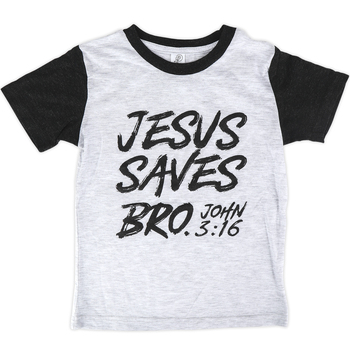
Anyone who has journeyed alongside me over the last few years will have heard me talk about how people in the church have hurt me in the past. It wasn’t too long ago that I graduated from seminary and took a year-long break from going to church because I had too much anger and hurt attached to regular church attendance. This is my trauma, my wounds that I am working through with my therapist, and they can affect much of how I see the world. They have also been a cause for seasons where I have walked away from the church, and I do not want the same experiences for my daughter.
Thankfully, she’s only two, so she can’t read and probably wouldn’t associate the writing on this shirt with the Jesus who she knows loves her. “Jesus Loves Me” is one of her go-to bedtime songs. And yet, she will grow up and soon be able to read. How do I help her see that some people will wear “Jesus” on their shirts but act antithetically to his love? How can I teach her to separate Jesus from people who claim Jesus? How do I raise her to love God while living around a “Jesus Saves Bro” Christian culture?
Jesus Loves and Saves Everyone
I think the first step for my family has been finding a church home that does not propagate a form of Christianity that enables hegemonic masculinity. The word hegemonic denotes superiority over not only other forms of masculinity but also the whole gender order. This view of masculinity is what lies behind rape culture, certain forms of domestic abuse, etc. Another phrase used for this kind of masculinity is “toxic masculinity.” A lot of what I have read regarding hegemonic masculinity comes from a seminary paper that focused on college-aged men in different settings, but my research suggested that hegemonic masculinity is internalized from a young age. A lot of my views have changed since I wrote that paper, so I won’t upload the paper here. Instead, I want to discuss how “Jesus Saves Bro” gives me hegemonic masculinity vibes.
God is so much more complex than one gender can represent. Jesus as the Word become Flesh is male, but the Triune Godhead is so much more.
It’s the Bro. It’s the way the phrase “Jesus Saves” has been adapted to fit a cultural norm from the greater western culture that I have experienced most alongside hegemonic masculinity. So much about the words we say can affect how others interpret the message of the gospel. Take my conversation earlier this week regarding God as genderless. The subject arose because I used male pronouns for God in the paperwork that I sent to UMC leadership in my district. My district’s superintendent is a woman who has spent her career in an area of Texas where woman pastors are not the norm and where the dominant theological voices are against the ordination of women and others. The language in my papers brought out something in her, to the point that she mentioned it to me as something to think about, and rightfully so, as I am not able to be more sensitive to those whom I might work alongside in ministry. The language excludes other genders from the Imago Dei, asserting that God is only masculine or male when the reality is that God is so much more complex than one gender can represent. Jesus as the Word become Flesh is male, but the Triune Godhead is so much more.
Using the moniker “bro” as a form of address when advertising salvation through Christ highlights a similar exclusionary trend in how we discuss people. Society as a whole has been discussing this trend over the last decade or so: changing forms of address from male-centered language (e.g. mankind, guys, etc.) to more gender-inclusive language (e.g. humanity, y’all, etc.). And it’s a trend that was and is mocked by the church culture in which I grew up. I can remember church leaders purposefully referring to a mixed-gender group as “guys” to subvert the “corrupting culture of the world.” In the culture war of the early 2000s, evangelicalism took a stand against egalitarianism and sought to “re-masculate” Christ. A great example of this trend can be seen in the ministry of Mark Driscoll at Mars Hill Seattle, most recently critiqued by Christianity Today’s The Rise and Fall of Mars Hill, specifically episode 5 “The Things We Do to Women.” However, the need to project a strong masculine front in the church dates back even further in evangelical history (see Kristin Kobes Du Mez‘s Jesus and John Wayne: How White Evangelicals Corrupted a Faith and Fractured a Nation where she traces this back to Billy Sunday in the late 19th and early 20th centuries).


As a man who did not (and does not) fit into the masculinity that was tied to Christ-likeness by preachers like Mark Driscoll or writers like John Eldridge, I struggled with my identity in Christ for much of my young-adult years. My wife also grew up in that same culture, and we’ve discussed much of how this culture affected her view of herself and God. Spoiler alert: it did more harm than good, for both of us. So then, I ask myself, “How should I raise my daughter so that she will not be affected by the same ideology?” Like I said, the first step is finding her a church community that does not propagate the views on gender around which my wife and I grew up. I am so thankful for the UMC and its leadership who are not only challenging my internalized biases, allowing me to better model true Christlike masculinity for her, but who also have a hand in helping my daughter grow in her love for God and others.
The second step is to talk with my daughter about instances where this ideology is expressed. For example, the boy in today’s incident didn’t really get many redirections from his parent. He was physical with other children while in the play place, yet the parent didn’t really keep him from inflicting harm. One family left after their son came out of the play place in tears. I eventually left too because I didn’t want my daughter to end up being hurt more. So my wife and I sat down with our daughter and asked her about how she felt and tried to redirect the afternoon into a celebration of her bravery in going down the slide all by herself. We rearticulated a message we have been teaching her: No one touches her body without her permission. As she grows older, these conversations will become more in-depth, I am sure, but it is not too early to teach proper boundaries and help her understand appropriate behavior.
I grieve the fact that this is the world we live in, that I have to be thinking of how to safeguard my two-year-old daughter from people who would do her harm because of her sex.
I grieve the fact that this is the world we live in, that I have to be thinking of how to safeguard my two-year-old daughter from people who would do her harm because of her sex. I know this might seem like a bit of a leap from some random boy grabbing her on the slide, presumably because she was just taking too long to leave the slide, but that boy will become a man who could grab her to do far worse. This is where my wounded mind goes as my own trauma colors the world around me. I want my daughter to know that no one has the right to push or shove her around, to grab her however they want, etc. I am still new to this, too, so feel free to share any tips or tricks for teaching bodily autonomy that you have picked up in your experiences. We all have so much to share with each other.
 Allention